Lesson 1
Why Change Is Hard (and How We Can Make It Easier)
Featuring Insights From

Lisa Longley
Vice President, Weber Associates

Lauren Erera
Principal, Weber Associates

Anya Macleod
Principal Consultant at Loopio
Learning Goals
Understand why most corporate changes fail
Learn what change management does
Assess your readiness for change
Table of Contents
- Understanding the Scale of the AI Transition
- A Hard Truth: Most Change Initiatives Fail
- What Is Change Management?
- Example Changes You Can Make in Your RFP Process
- Assignment 1: Change Readiness Assessment
Over the past few years, the RFP process has changed at an accelerated rate. According to the RFP Trends Report, 68% of teams have adopted generative AI into their process. Many evaluators are now using digital scoring tools for their first pass, which changes the considerations for responders (a machine looking for keywords and flagging where you’ve copied from the last RFP is different than a human skimming). And evaluators’ expectations—already sky-high—require an even faster pace of work, with AI being leveraged on the procurement side as well.
Understanding the Scale of the AI Transition
The percentage of RFP teams using AI in their response process has more than doubled in just two years:
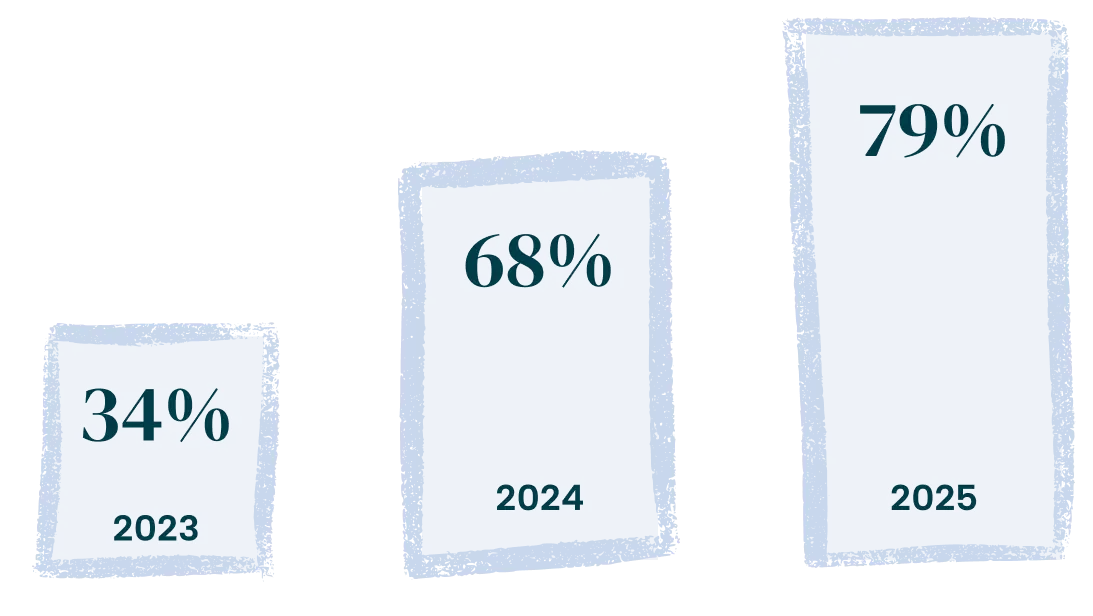
We are witnessing one of the most aggressive technological shifts in the history of the RFP industry. In an era where technology moves faster than human habits, the ability to lead your organization through these shifts is the most valuable skill a proposal leader can have.
“Buyers have asked for faster response times,” says Lisa Longley, Vice President, Weber Associates. “They want more data. They want more personalization and they’ve asked for more complexity—and they’re not giving any leeway on the other side of it for the people who are trying to respond.” All this means that you need to constantly tweak and adapt your process to meet these new demands.
If you’ve spent any time in the RFP field, you might be thinking, well, duh.
RFP people are pretty used to change. “When is it not evolving?” says Lauren Erera, Principal, Weber Associates. “Everything from the RFP process to the strategy to win to the evaluation criteria—all of that is changing constantly.”
But this isn’t just about you. While you might be prepared for change, getting the rest of your organization on board can be a real challenge. To succeed, you need to not only change your own habits, but also convince your team to do the same (and ensure those changes stick).
The stakes are high. Most changes fail. If you want to be the exception to the rule, you have to learn how to strategize, anticipate problems, persuade your team, and reinforce the change.
That’s the subtle art of change management, and in this course, we’ll teach you how to master it.
A Hard Truth: Most Change Initiatives Fail
Twenty-five years ago, the Harvard Business Review first reported the now widely cited statistic that 70% of corporate changes fail. Though, surely things have gotten better since Y2K, right?
Not really. More recent research from The Standish Group shows that only 31% of major IT projects and implementations (a type of change management that’s easy to measure) are entirely successful. That’s one percentage point better than when Brad Pitt and Jennifer Aniston were still married.
Blame human nature: You might have heard the oft-reported stat that it takes 21 days to change a habit. The scientific consensus is that it’s more like two months. Now, imagine trying to get a whole team to adopt this habit all at once. It’s a miracle that even 30% succeed.
The larger a company is and the longer it has existed, the more baggage it accumulates. Systems, unwritten rules, outdated tech—it all adds up. Something that seems like a simple problem to fix may actually go a lot deeper than you think. That’s how you get everyone going in circles and getting more and more experts involved because that oh-so-simple change actually touches on a lot of different things. And if you touch one it’ll break something else, and the meetings become interminable, and nothing ever gets done, and everyone means well but they all have their own priorities to deal with, and frankly, this particular change is not a priority to them.
The good news is that change management gives you a framework to anticipate and proactively mitigate these issues so you don’t get stuck in an endless meeting loop that goes nowhere. Here’s how.
What Is Change Management?
According to Harvard Business School: “Change management is the process of guiding organizational change to fruition, from the earliest stages of conception and preparation, through implementation and, finally, to resolution.” In non-business-school speak, change management is about providing the systems and support that help new actions stick—rather than reverting back to the “way we’ve always done things.”
Change management is about providing the systems and support that help new actions stick—rather than reverting back to the ‘way we’ve always done things.’
This is easier said than done. It’s the art of getting others to change. It’s strategy, persuasion, and a kind of corporate diplomacy. “These things don’t always come naturally for those of us who tend to be focused on execution and results,” says Anya Macleod, Principal Consultant at Loopio. “Generally, RFP pros gravitate towards pragmatic systems and processes rather than building networks of influence.”
But people are at the heart of the systems you so desperately want to change. And in order to ensure your change sticks, you need to learn how to communicate the change and get them on your side.
If that sounds scary, please don’t panic. We’re not going to plunge you right into the deep end—we’re going to take things step by step. You don’t even need to start persuading your team until Lesson 5, and we’ll walk you through how to build your communications plan so you can go into those conversations with the best chance of success. With the right preparation, you’ll find it isn’t nearly as hard as you might have thought.
Effective change management includes:
- An identified problem/opportunity: What isn’t working?
- A goal map: Where are you now and where do you want to be?
- A plan: How are you going to make the change?
- A communications strategy: How are you going to inform your stakeholders of the change?
- A way of tracking metrics: How will you know when you’ve been successful?
- A long-term support strategy: How will you ensure the change sticks?
Over the next six lessons, we’ll help you come up with an effective change management strategy for your business so you can feel confident in your ability to enact change, whether that’s an RFP software implementation, an update to your team structure, a process overhaul, or something else entirely.
Example Changes You Can Make in Your RFP Process
Shifting Your Process
- Implementing a go/no-go process
- Adding a step to do a kickoff call with everyone involved
- Spending more time on personalization
- Reserving more time for editing, design, or other refinement
Updating Your Tools
- Implementing RFP software
- Adopting AI
- Migrating your content into a dedicated tool
Refining Your Team Structure
- Getting a dedicated RFP person for the first time
- Changing who owns RFPs in your organization
- Formalizing the roles of subject matter experts (e.g. getting their manager to allocate time to support RFPs, measuring them on RFP participation, etc.)
Overhauling Your Content
- Refreshing your content to incorporate new offerings or market changes
- Combining multiple content repositories after an acquisition
- Deleting out-of-date, incorrect, or no longer relevant content
Your process may involve one of these changes, several, or others entirely.
Now that you understand the why and how of change management, let’s get into your first assignment.
Assignment 1: Change Readiness Assessment

Estimated completion time: ~5min
Wait, we’re getting homework in the first class? You betcha. We’re jumping right in so you can get the most value out of this course.
Before you embark on any big change, it’s important to make sure that you’re ready. Since such a high proportion of changes fail, it’s critical to ensure that you have the right pieces in place.
This is a quick self-assessment that will help determine how ready you are to make a change to your RFP process. You’ll leave having a better understanding of where your resources are and where there might be gaps you need to address.
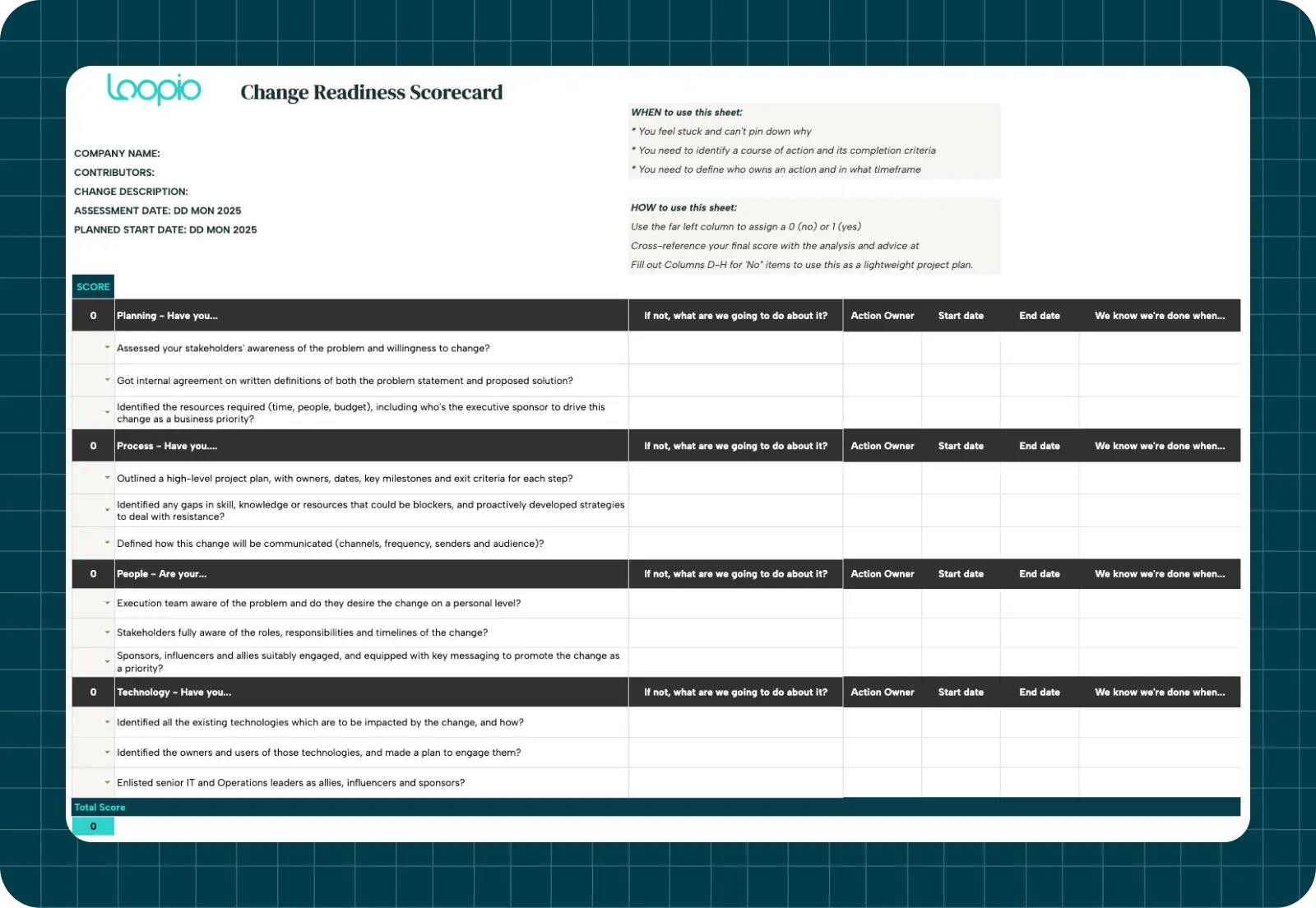
Important note: Don’t kick off your big change until you can attain at least a passing grade of at least 50%.