Lesson 5
How to Rally Your Team
Featuring Insights From
Lisa Longley
Vice President, Weber Associates
Jacey Wallis
Director of Proposals & Business Development, Weber Associates
Natalie Giles-Grant
Head of Bid Management at OneAdvanced

Anya Macleod
Principal Consultant at Loopio
Learning Goals
Identify your key stakeholders
Understand the art of persuasion
Build a communications plan
Table of Contents
- Identify Your Players and Their Roles
- RACI for change management
- The Art of Persuasion
- Assignment 5: Your Communications Plan
Most change projects fail because leaders do not communicate to stakeholders why they should care.
“If you’re asking me to make a change but not giving me the ‘why,’ I don’t know how it’s going to make what I do better,” says Lisa Longley, Vice President at Weber Associates.
While the reason for the change may be crystal clear to you, don’t assume that others will immediately be as excited. Where you see a fresh opportunity, they might just see more work they didn’t sign up for.
Lisa explains: “From my perspective, I’m already great at my job. Why do I need to use a different technology or platform? Why do I have to change my process? I already have great relationships with my clients. I already know what they need. Unless it’s instilled from the very beginning, why we’re doing this and what the ultimate impact is going to be, you’re gonna lose people immediately.”
“Unless it’s instilled from the very beginning, why we’re doing this and what the ultimate impact is going to be, you’re gonna lose people immediately.”
This is where the art of persuasion comes in—that thing that’s so critical to change management, but can feel so intimidating for RFP people. Because talking about process is one thing, but going around and telling people that they need to do their jobs differently…well, that’s another thing entirely.
But we’re going to let you in on a little secret. The work we’ve been doing for the last four lessons—dissecting your process, identifying opportunities, setting goals, and making a plan— forms the groundwork for getting your team on board. You already have all the materials you need to persuade your people. Today, you’re going to learn how to put them to good use.
Identify Your Players and Their Roles
Before you can get started persuading your team, you need to figure out who, exactly, should be involved. The good news is you’ve already made a start. By mapping your process, you already have a good handle on the steps that an RFP passes through at your organization and, by extension, who touches it.
Now it’s time to identify these people and figure out what kind of convincing they’re going to need. The best way to do this is to create a stakeholder registry—in other words, a list of everyone involved in the process.
This can include:
- The RFP person or team
- Exec leadership
- Sales team
- Marketing team
- Product / technical experts (SMEs)
- Anyone else who might be impacted
Within this list, you’ll have folks who will be decision-makers, ones who can play the role of influencers, and those who are going to be impacted by the change and need to be informed. You may have heard this referred to as RACI: Responsible, Accountable, Consulted, and Informed. A RACI is used to identify the different roles people play in a project. This can be a helpful way of thinking through the different parts you and your team are going to play in the change you’re making.
For each change you make—or a group of related changes—think about who is going to fulfil each role.
RACI for Change Management
| Role | Activity |
|---|---|
| Responsible | Implements the change |
| Accountable | Is responsible for ensuring it happens |
| Consulted | Gets asked for their opinion |
| Informed | Is told about the change |
For instance, if you, as the RFP manager, are introducing a new AI-assisted drafting process, you’re ultimately accountable for the change. The Subject Matter Experts (SMEs) you work with may be responsible for validating AI-generated content, your executive sponsor is consulted, and your Sales team is informed.
The Art of Persuasion
Now that you have your players identified, how are you going to get them on board with your plan?
Let’s start with executives. Among the different roles in your project, your executive sponsor(s) are probably your most pivotal. These are the people who have the power to influence their teams—and can make your change a priority (out of a list of many other competing tasks).
“If you can get senior management buy-in, then that really filters down into their teams,” says Natalie Giles-Grant, Head of Bid Management at OneAdvanced. How do you get executives to care? It’s all about making things they care about into your priorities. “You need to demonstrate the ROI on it and the benefits of your solution,” she continues. To be clear, this might not be ROI in the financial sense, but more how it will benefit them and help them complete their present goals.
To do this, it helps to put yourself in your executives’ shoes. What are the results they’re measured on? This might include revenue, efficiency, time and cost savings, or other metrics specific to their role. Think about how you can align the change you want to make with the priorities that matter most to them.
Some research-backed benefits of improving your RFP response process to highlight in conversations with your team:
- Adopting RFP software can massively increase your capabilities: RFP software users submit an average of 171 responses per year vs. 120 for non-users.
- RFP software users report feeling significantly more satisfied and less stressed than their peers who aren’t yet using these tools.
- Top performers are more likely to be leveraging generative AI, more likely to be using it on a weekly basis, and are generally more enthusiastic about the tool and its potential.
- Using a go/no-go process is correlated with elite performance: 86% of top performers (those who win more than 50% of the RFPs they participate in) are using one.
For all these insights and more, check out our 2025 RFP Trends and Benchmarks Report.
When it comes to your other players, focusing on the benefits to them and their roles is also going to be critical. For instance, the team at Weber Associates, a sales and marketing consultancy, ran into some resistance with a new client as they were trying to make their process easier and more streamlined.
“We came in to support a client with a small team who needed some extra hands,” says Jacey Wallis, Director of Proposals and Business Development at Weber Associates. “But their project manager was really reluctant to have us—I think she thought we were out for her job.” But bid by bid, they slowly won her over. “We made her look good by picking up pieces from her team that had fallen through the cracks, by chasing down subject matter experts, and by ensuring compliant responses—something they’d been struggling with.”
Gradually proving their value and showing that they only had her best interests at heart helped the team build trust and ultimately converted this client from a skeptic to a fan. “Now, she’s our biggest supporter. It just goes to show that the right people in the right place can change someone’s attitude—and it’s all about showing them that we’re there to help them.”
As you think about making your change, it’s important to frame it from the perspective of the people you’re asking to change and focus on the benefits for them—the WIIFM, or “what’s in it for me?” That’s exactly what we’ll explore in today’s assignment.
Assignment 5: Your Communications Plan

Estimated completion time: ~60 min
You know who is going to be involved and how to persuade them—now, it’s time to put all that together into a communications plan.
Fill out the template below with key communications opportunities. These might include things like recurring meetings, an internal newsletter, or specific conversations you’ll want to schedule with key influencers or teams. Decide who is going to attend as a representative—they’ll be playing the role of “diplomat” to help persuade the person or group on the benefits of the change.
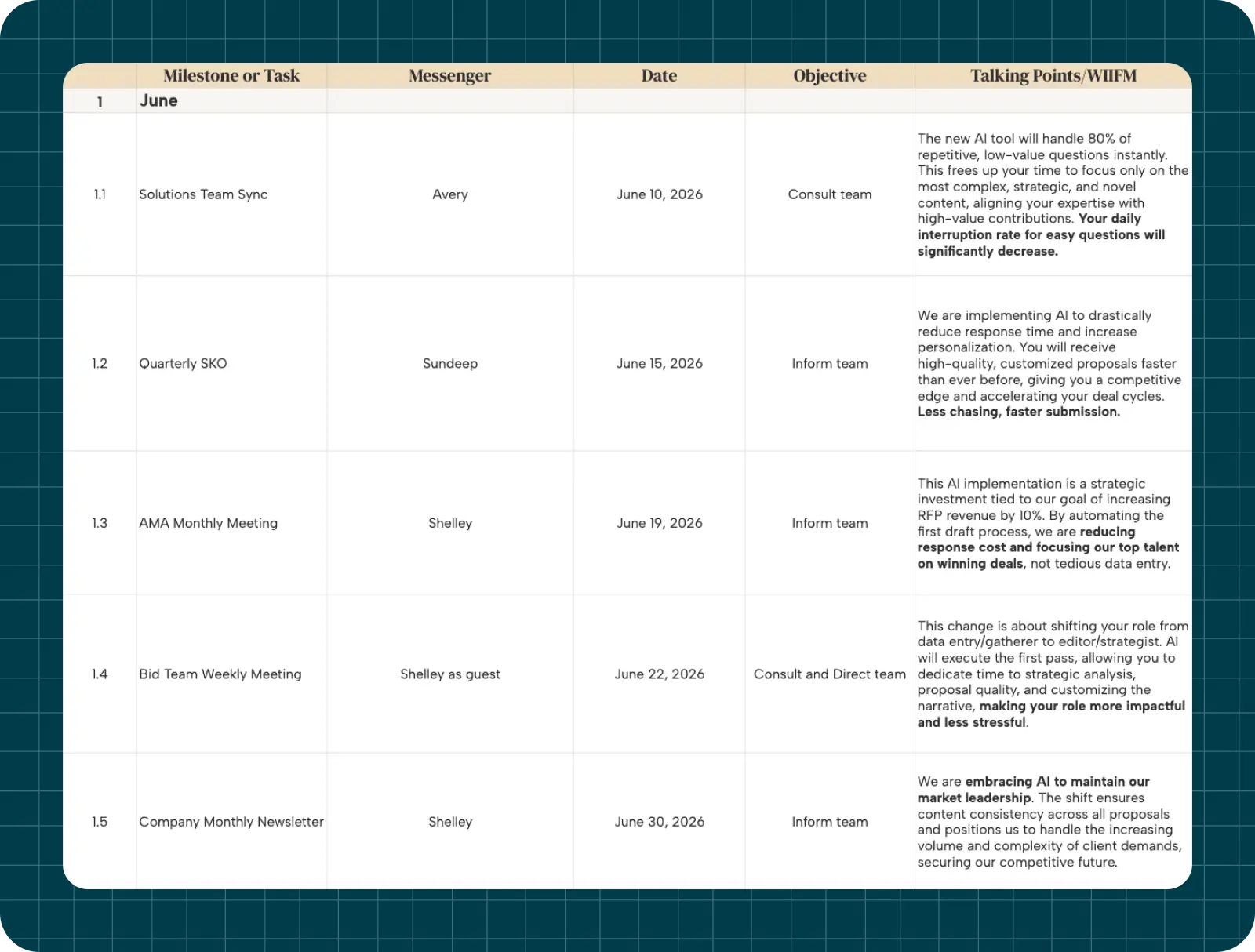
Finally, make sure to draft some talking points that are tailored to each group specifically addressing the “WIIFM” (what’s in it for me?) How do they stand to benefit? Why will this change make their lives better and easier? How does it relate to the things they care about?