Lesson 2
Define Your Problem—or Opportunity
Featuring Insights From

Claire Walker
Head of Solutions at OneAdvanced

Natalie Giles-Grant
Head of Bid Management at OneAdvanced

Anya Macleod
Principal Consultant at Loopio
Learning Goals
Understand the stages in the RFP process
Get clear on how your process currently works
Create a process map to identify risks and opportunities
Table of Contents
- The RFP Response Process Is Not for the Faint of Heart
- RFP Process Map
- Why Bother Making a Process Map?
- Example Changes You Can Make in Your RFP Process
- Assignment 2: Process Map
If you’re taking this course, there’s probably something in your RFP process that you want to change (or you’re just really eager to learn, and we love that for you). Maybe you already have an idea of what action you want to take or maybe you just have the nagging sense that something could work better, but you can’t pinpoint what.
Either way, the first step to making this change is to get clear on your problem or opportunity. To do that, you need to understand how your current process works. Not how it works in theory, but what’s actually happening. This is critical, especially if you’re working on implementing a change that involves AI since you can’t automate what you don’t understand. Before you can layer in Large Language Models (LLMs) or automated workflows, you need to know exactly where the data lives and where the human touch is irreplaceable.
In this lesson, we’ll share an overview of the RFP process, discuss why and how to create a process map to assess how well yours is currently working, and identify opportunities for improvement. You’ll walk away with a detailed process map that will allow you to pinpoint exactly where those opportunities are and (if relevant) help you decide where any new process steps will fit.
The RFP Response Process Is Not for the Faint of Heart (Especially in the Age of AI)
To risk stating the obvious: Responding to an RFP is no simple matter. It’s a complicated, multi-step process involving multiple contributors and teams coordinating across different tools to meet a tight deadline. Oh, and that’s just for one RFP. If you’re anything like the average response team, which responds to 153 RFPs in a year, you’re definitely handling multiple responses at any given time.
What that means is you’re doing a lot of the same things over and over. Think of it as a factory assembly line involving many different inputs, processes, and contributors. The bad news is that if your system is inefficient, the volume of RFPs you’re responding to is going to magnify these inefficiencies. Before you know it, those inefficiencies compound and you’re like Lucy in the chocolate factory, in way over your head with pieces flying at you left, right, and center.

The good news is you can build systems to help your process run smoother—and those changes will cascade out to every RFP you touch. But to get there, you need to understand exactly what those processes are. For many companies, these are implied. In order to improve your process, you first need to make these steps explicit.
Broadly speaking, every RFP response process goes through the same series of steps, from initiation to completion.
- Notification: The RFP enters your system.
- Assignment: Someone (or a team) takes responsibility for it.
- Go/no-go decision: Sales make a choice whether to pursue the RFP or not. Some response processes end here with a decision not to move forward.
- Project creation: The project owner kicks off the response process.
- Groundwork: The owner/team reads the RFP and starts to strategize.
- First pass: The owner/team fills in common answers based on existing content.
- Collaboration: The project owner assigns questions to SMEs.
- Review: The owner/team finalizes answers and makes edits.
- Project export: The project owner submits the completed response.
- Integration: The project/owner team updates existing databases with new information.
RFP Process Map
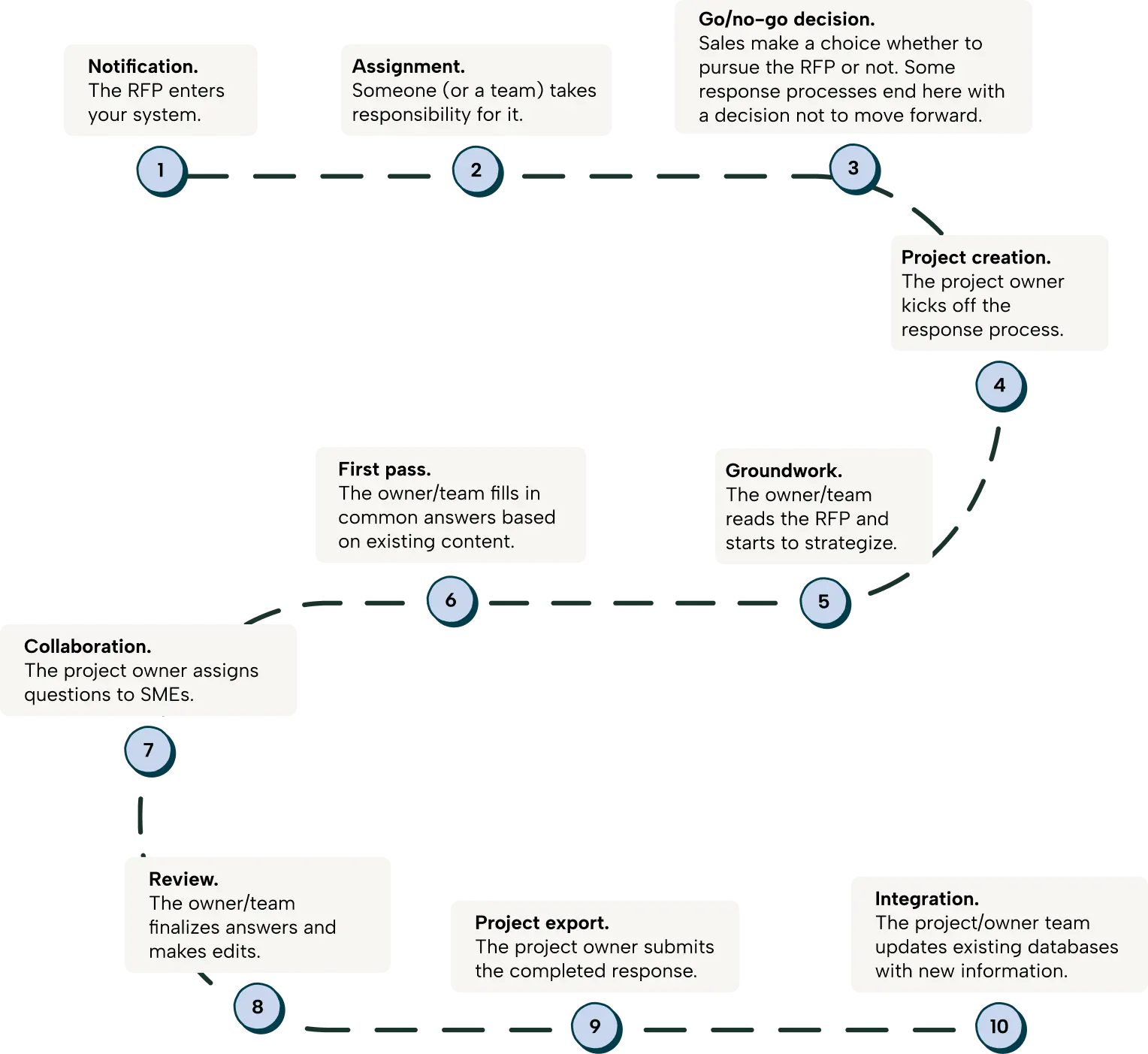
Even if you’ve never formalized your process, these steps will likely be familiar to you. You might call them something different, but it’s likely that any RFP you pursue will pass through most if not all of them.
Because it can feel so chaotic when you’re in the thick of it, it’s essential to take a step back and visualize your process. This will make any problems or opportunities crystal clear and provides a starting point for discussing any changes with your team. That leads us into mapping your current process.
Why Bother Making a Process Map?
If you already have a sense of the change you want to make, it can be tempting to just plow ahead. “I already know what’s going wrong,” you might think. Or, “We’re just going to add a new process step here, how hard can it be?”
But it’s worth taking the time to get clear on your process now, to avoid any potential headaches later on. This is for a few reasons. For one, people might not always be following your current process in the ways you think they are, and it’s important to uncover that now rather than being surprised later.
For instance, maybe theoretically, salespeople are supposed to be using answers from a content hub that you maintain, but in reality, they’re copying and pasting from marketing collateral that’s three years out of date.
If you don’t investigate, you’ll never know.
Example Process Steps You Can Fix Early:
- People aren’t actually using the process → Find out what they do instead
- The process is duplicative → Can there be fewer steps?
- The process is from a long time ago → Can it be updated?
- There are unnecessary approvals that are causing delays → Can they be streamlined?
It’s especially worth studying your process and considering how it will change before adopting software. The team at OneAdvanced discovered this when they implemented RFP software for the first time. “The mistake we made was we took our process and we tried to add software on top, without thinking about how the process was going to change as a result of the software,” says Claire Walker, Head of Solutions at OneAdvanced.
And while they were able to implement those process changes after the fact, it would have saved them time and headaches to make those decisions up front. “When I came into the business, I ended up having to rewrite all of our processes for bid management,” says Natalie Giles-Grant, Head of Bid Management at OneAdvanced. Taking the time to revise your process at the beginning can help you avoid these kinds of unexpected roadblocks later on.
Finally, having a clear process map gives you a document you can point to when you’re explaining the necessity of changes to senior leadership or your team. You’ll be much more effective in convincing people to change if you can pinpoint a clear problem or opportunity. For example, which of the following sounds like a more effective catalyst for change?
Option A
“We have to do something about handing in proposals at the last minute.”
Option B
“We’re taking too long at the first pass because the RFP response team is too busy writing net-new responses for each proposal. If we implement generative AI to help complete the first pass, they can focus on tailoring responses, improving time to completion by X hours.”
Option B, right? And that’s because it identifies a clear problem and an opportunity to fix it. That’s an insight you can only get if you’ve taken the time to study your process.
In sum, it’s worth taking the time to make a process map now so you have a clear picture of what you’re dealing with. This will not only reveal any gaps in your knowledge, but will also help you anticipate problems and bring your team on board with the upcoming changes.
Alright, that’s enough background. Let’s get into making your process map.
Assignment 2: Process Map

Estimated completion time: ~30 min
Download the Process Map below to go through each step of the RFP process discussed in this lesson and answer a few guiding questions.
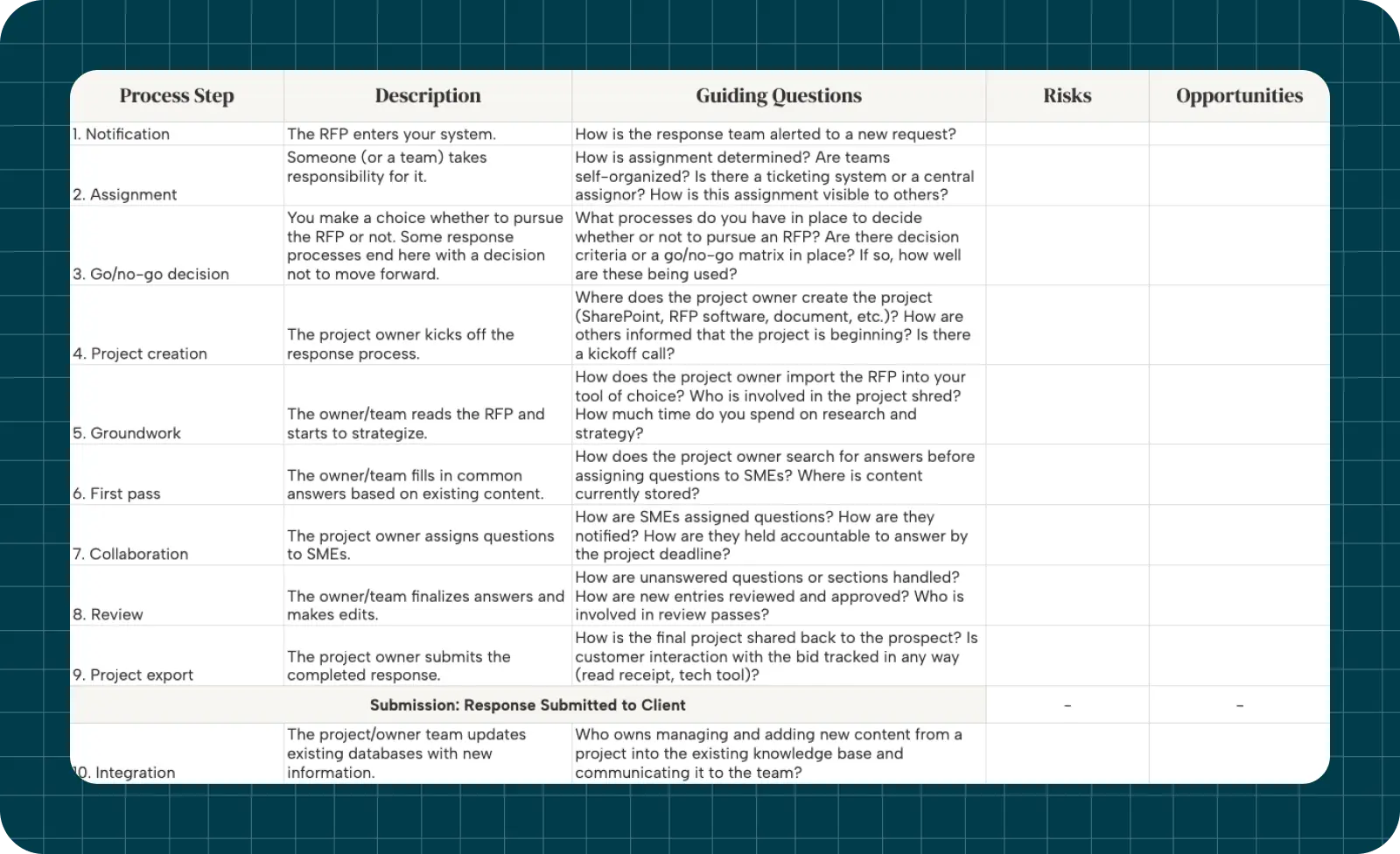
Then, use your answers to these questions to fill out the following template to create a high-level overview of your process and identify areas of risk or opportunity.
For each stage in the process, think about:
- What isn’t working? These are your risks.
- What else could you be taking advantage of? These are your opportunities.